A cut above the rest
By Graham Downing
Graham Downing meets bladesmith and knife maker Dean Boyd
The knife is perhaps the simplest and most basic tool of the countryman. There are hundreds of thousands of designs on the market and even the most pragmatic product man performs the tasks required of it by the deer-stalker — gralloching and primary field preparation of a carcass — and in that sense, all knives are equal. But some are more equal than others.
"It's obvious to see, but if you use the correct tool for the job, then it will make the job a lot easier," says Dean Boyd.
With a background as a toolmaker in the Royal Engineers and then as a military bushcraft instructor, Dean is one of a tiny number of bladesmiths in the UK and he runs Emberleaf workshops, producing custom-made knives.
"Although there are lots of knives available, most are designed for the US market. Europe is horribly catered for, and there are very few British knife-makers that make hunting knives, so a lot of stalkers default to the classic bushcraft knife."
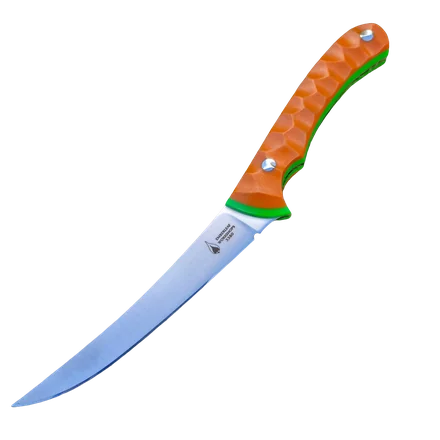
It's designed by a hunter for hunters, with the length to reach the heart from the sternum and to work around the anal cavity of a deer carcass, and a deep grind to enable a cutting edge to be put on the blade when applying pressure. The width of the knife is possibly its most useful element, [and we believe this by using specialist steel].
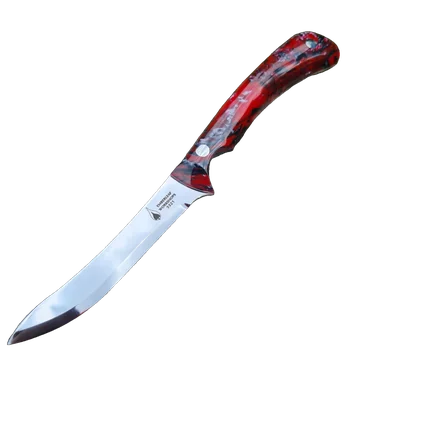
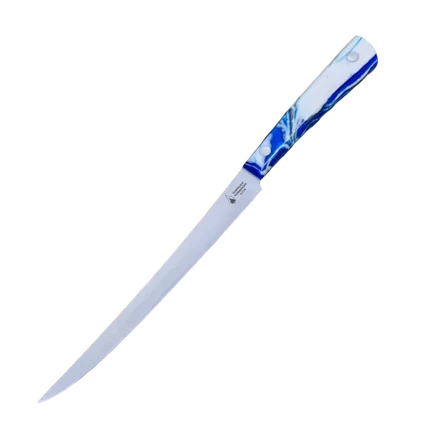
The Cael — a name derived from a Celtic word for slender — was originally intended for stripping breast meat off bird carcasses. It comprises a narrow bladed knife with a relatively thick, curved blade that is "Scandi" ground to 12.5 degrees on each side, the optimum angle for setting a cutting edge.
"It started off a centimetre longer, but the design was then refined over time and the tip was curved back so that you had a deep point to reduce the risk of puncturing the gut when gralloching."
A blade of a hunter's knife can be very similar in shape to a bushcraft knife, but the design of the handle channels your fingers to hold it in a different way. A knife is controlled by the thumb and index finger, and their position controls how a knife is going to behave. So a hunter's knife often has a less dexterous [grip] beyond a knife which you hold in your fist.
…is incredibly strong. Most off-the-shelf knives could not be as narrow as this without being very weak.
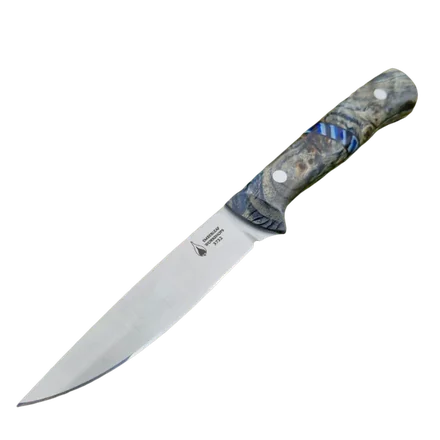
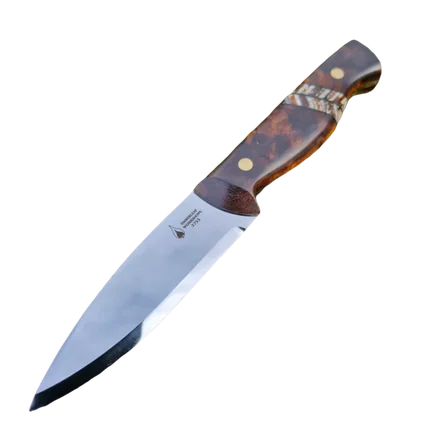
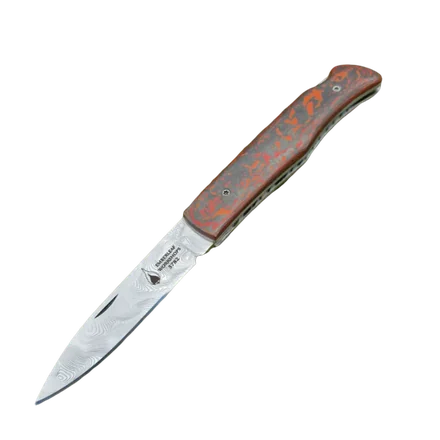
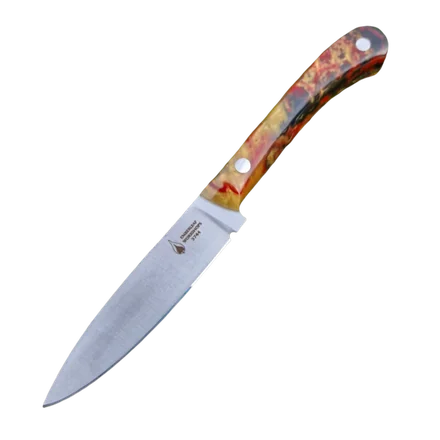
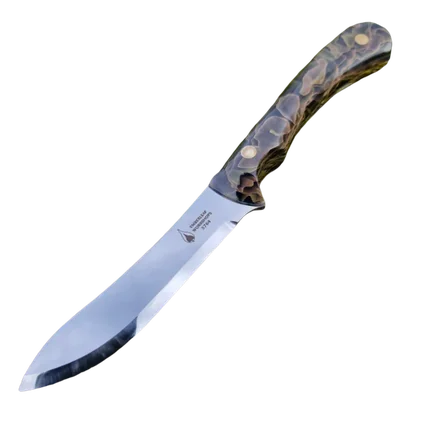
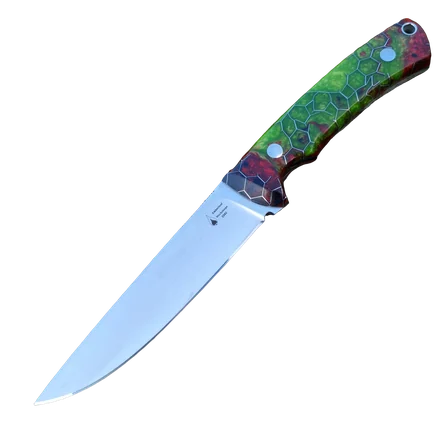
And that, in one might say, is the point. Dean's knives are definitely not off-the-shelf: they are made specially to order, with every variable being selected to suit the individual customer, from the type of steel for the blade through the overall design and grind pattern, to the material for the handle. Since there are 40 steels and over 1,800 readily available handle materials, the permutations are virtually endless. No individual handmade knife is ever going to be the same as the next, and that is regarded as one of the pleasures of owning such a product.
"If everyone wore the same clothes, then the world would be a very boring place, and it's the same with knives," says Dean. "Factory knives kill off a customer's life, but these knives are custom made, so they can be completely personalised. Even if you ordered the same knife twice, they would probably be different, just because that's the nature of handmade things."
Selection of an appropriate blade steel is perhaps the start of the journey in making a knife. All steels have slightly different characteristics, such as corrosion resistance, edge retention and ease of sharpening, and a balance must therefore be struck as to the most appropriate material for the particular application.
"A steel is a crystalline structure, so if you start to grind to a point a material that is not designed to hold a point, then it will never hold an edge and you won't be able to sharpen it properly. That's why 20 years ago you could never sharpen a stainless steel knife, because the material was not designed to be sharp. Now we have modern stainless steels that are blade steels, like AEB-L, RWL-34 and 14C28N which is a nitrogen-based steel with very little carbon content and so extremely high corrosion resistance."
When it comes to handle materials, then almost the only limit is that of your imagination. Wood, bone, horn and other natural materials are of course hugely popular. Dean has handled knives with 22,000-year-old mammoth ivory, fossilised woolly rhino horn, megalodon teeth, cow bone, moose antler and a huge range of rare and exotic woods from bog oak to sumptuous California buckeye burl. Most handle wood is stabilised by means of a resin treatment, which makes it totally impervious and prevents the material from moving or altering shape as a result of changes in humidity or temperature. This prevents the development of ridges or dirt traps in the handle, while of course it also ensures that a wooden-handled knife conforms to the requirements of modern hygiene legislation.
There is then of course a vast range of artificial materials, [such as kirinite, micarta and similar composites], with almost endless variations in colour and appearance. In between, however, comes a half-way house: stockboard is wood with carved holes and grain that have been filled with coloured thermoplastic resin, to create a kaleidoscopic material which at once reflects the natural world as well as high technology.
Having been cut out and shaped, the blade is hardened precisely for 12 minutes in a digitally controlled kiln, quenched in olive oil and then tempered to relieve stress. It is then tested for hardness three times with an industrial diamond before the handle is fitted and the final edge is ground to up to three times surgical standard.
"We take them to about 9,000 grit or even 12,000 grit on some cases. An NHS scalpel is 3,000," comments Dean.
Finally the knife is polished, and etched with a logo and possibly the new owner's initials, and the sheath is made. The whole manufacturing process will take around one and a half working days. Of course the cost is rather more than that of the sort of product you will find in your local gunshop, and depends to some extent on the materials you choose. A handmade [deerstalking knife] handled in stabilised poplar may be had for around £100, while rare African Sunsasapele [sic] coupled with mammoth ivory will [send] you upwards of £1,000. But there are no [woolly] mammoths around these days. Moreover, while one of the makers of the Japanese steel for Emberleaf is 80, [the apprentice only produces three to five knives a year].
But you can be guaranteed that the knife will be a thing of beauty and the perfect companion which will last forever. Truly a knife for life.
Captions: "Profiling a blank knife ready for heat treatment" · "A Cael made in AEB-L and handled in stabilised California buckeye burl" · "A Bran knife made in 65-layer SG2-core [Suzieruquolu] laminated steel, handled in 20,000-year-old woolly mammoth ivory supporting a stainless steel pommel"
Visit Emberleaf workshops at: www.emberleaf.com
BDS Journal, Summer 2015. Written by Graham Downing.
All press features